
University of California Press, November 2024
You can order the book from:
UC Press (for US and Canada, use code UCPSAVE30 for 30% off)
Bookshop US | Bookshop UK | Libreria Universitaria IT | IBS IT | William Dam DK
if all else fails, from Jeff Bezos’ empire in Italy | US | UK | Germany
Click here to read a short Q&A about the book.
Appropriate, Negotiate, Challenge: Activist imaginaries and the politics of digital technologies examines the relationship between contemporary social movements and digital media, by considering how activists think about the politics of digital technologies and how they imagine the role of technology in their struggles for social change. I develop the term “technological imaginary” to study how social movements construct discourses about technology and its political implications.
The book argues that activists’ technological imaginaries are shaped by and shape the politics of contemporary movements. On the one hand, this means that technologies are imagined through a political lens, which is specific to each movement; this imaginative work takes into account the ideology of these movements and the political context in which they are embedded. On the other hand, technological imaginaries influence the political action of these movements, enabling some options, and constraining others. In particular, I suggest that although social justice-oriented movements are pushing back against Silicon Valley, their reliance on corporate digital technologies seems to limit their ability to imagine political and technological alternatives.
The premise of the book is that activists are exposed to a mainstream, dominant technological imaginary, deployed by Silicon Valley actors, which connects digital technologies to social change, and which is embedded in the technology created by these actors. The book examines how activists make sense of this dominant technological imaginary and of Silicon Valley technologies (such as Facebook and Twitter), by looking at how movements create their own technological imaginaries.
Through an empirical analysis of three contemporary leftist movements in Hungary, Italy and the United States, based on interviews, field observations, and a novel creative research method I created, the visual focus group, I propose a typology of activists’ technological imaginaries, based on how they respond to Silicon Valley’s imaginary: imaginaries of appropriation, negotiation, or challenge. In so doing, I show that movements’ imaginaries are shaped by the political ideology of activists and by the political context in which they exist, and that they shape how activists think about the political possibilities available to them.
Reviews
“A fresh and innovative approach to connecting technological imaginaries with social movements. Elisabetta Ferrari uses canonical influences to reinvent how we approach the question of mobilization. This book is a compelling and inspiring take on how mobilization becomes digitally remediated.”—Zizi Papacharissi, author of After Democracy: Imagining Our Political Future
“A timely book that renews and deepens discussions on digital technologies and social justice activism. Moving beyond hype around social media, Ferrari skillfully offers empirically rich and conceptually rigorous insights on activists’ imaginaries as well as the value of media technologies for activism and possibilities for creating change. A must-read for everyone interested in media and social movements.”—Tina Askanius, Professor in Media and Communication Studies, Malmö University
“Appropriate, Negotiate, Challenge is bold and imaginative scholarship. Ferrari provides fresh perspectives and rich data, illustrating how activist movements grapple with and ultimately make sense of the digital technologies they deploy. You will learn a lot from this book.”—David Karpf, author of The MoveOn Effect: The Unexpected Transformation of American Political Advocacy
The book has also been reviewed in Mobilization, Convergence, and Contemporary Italian Politics
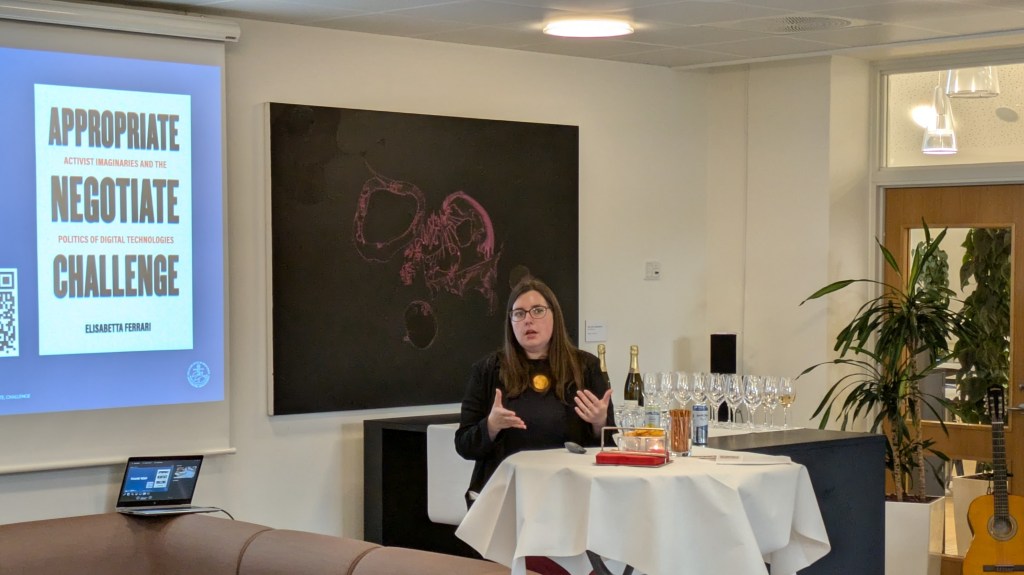

Listen to me talk about the book in this podcast for the New Books Network!
 Elisabetta Ferrari, Ph.D.